

Yamanashi / 山梨県 · Prefecture #8
There's something magical about waking up to the sight of Mt. Fuji.
If you're looking for a peaceful retreat, I highly recommend staying here for a night or two. Last weekend, we camped at Koan Motosuko Campsite in their lakeside tent area, with a front-row view of Fuji-san, and I really have no words to describe how magnificent it was.
The forecast said it would rain all weekend, but we went anyway and were rewarded with great weather and a breathtaking view of Mt. Fuji when we woke up. One of the most peaceful trips I've ever had.
📑 Table of Contents ▾ tap to open
KOAN MOTOSUKO CAMPSITE

You have to open the gate (there's a chain/rope) yourself every time you go in and out. The gate is closed from 10:00 PM until 8:00 AM. It's best to reserve online, because you can only check in during your assigned time slot. Arriving later is fine, but you can't check in earlier than your reserved time.
When I first tried to book, the only available time was from 16:00. A few days later, the 11:00 slot opened up, probably because of cancellations due to the weather. They also have cottages/cabins if you're not comfortable in a tent.
At this campsite, you can park your car next to your tent. We planned to be near the shore, but the wind was strong, and we thought it would be too cold and noisy by the water.
Instead, we found a spot on higher ground near the trees where we could set up our hammock. The ground was a little sloped, but still better than other areas. It was much more slanted near the water, so you'd probably have a hard time finding a comfortable sleeping position there.
We only realized this after barely sleeping that night, but at least now we know for next time. It's best to have your lower body on the downhill side so it doesn't feel like you're rolling down. I kept waking up because I was dreaming of falling. Ever had that kind of dream?

Our tent
On this camping trip, I learned to watch out for guy lines. Guy lines are the ropes on the sides of a tent that add stability with tension and bracing. I tripped over them twice at night. They're easy to forget, especially in the dark, so please don't be like me, and be careful.
The campsite is pet-friendly too, except for the cottages.
ACTIVITIES
There are lots of things to do here: windsurfing, SUP, kayaking, biking, hiking… you name it. You'll never run out of things to do. Or, if you just want to relax like we did, you can totally do that too.
We wanted to go paddling in the morning, but the wind was too strong, so we skipped it. You also have to wear a life jacket if you're going in the water.


There's an onsen near the lodge where you check in (please confirm its opening hours), but we didn't go because we planned to go somewhere else. They also have a 24-hour coin shower. I paid ¥200 for 2 minutes(?) of hot water. I forgot how much I put in, but I got about 8 minutes, and you can pause the water anytime.
MT. FUJI ON THE ¥1,000 BILL
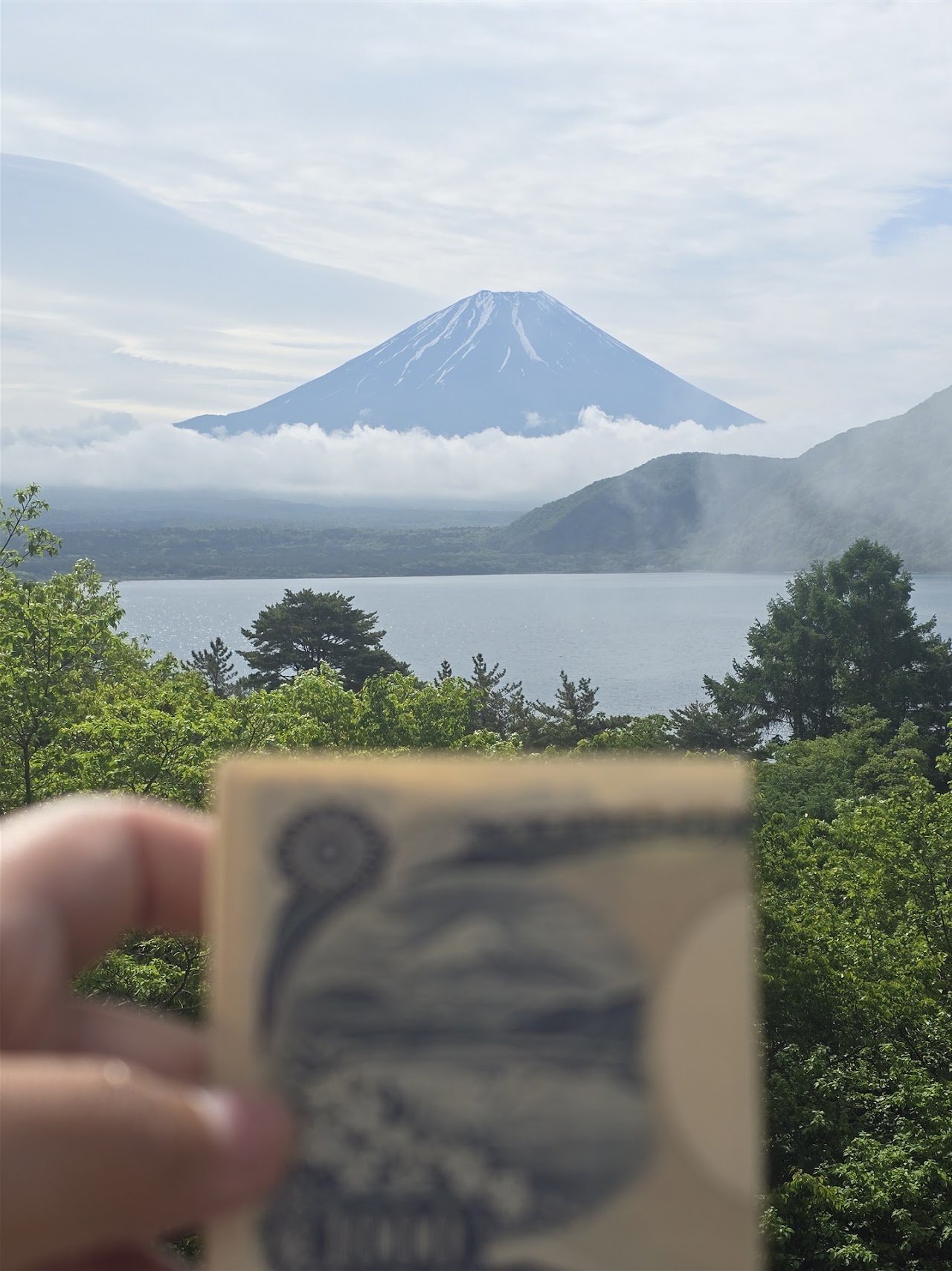
There's a hiking trail nearby up to the viewpoint that inspired the ¥1,000 bill.
If you look at the back of an older ¥1,000 bill, you'll see Mt. Fuji based on Kohan no Haru (Spring by the Lake), a photograph taken by Okada Koyo at Lake Motosu. The viewpoint is northwest of Lake Motosu, and the 1 km hike from the road takes around 30 minutes. The trailhead is near the toilet at Motosuko Observation Park. I read on Google Maps that you can also see the same view from Nakanokura Pass Viewpoint.
Okada is known as a pioneer of "Mt. Fuji photography". He called Mt. Fuji "Fujiko", because in Japan, female given names often end in "ko". Some of his photographs appeared on Japanese stamps too. He said that no matter how many years he photographed the mountain, he could never capture it as he envisioned, so he never stopped.
He loved Fujiko ever since he fell in love with her at 21.
If you're here in spring, around the end of May to early June, you can also go to the Fuji Shibazakura Festival. I loved it so much that I went twice just to catch the flowers in full bloom. That was in 2017; now it's easier, because you can check other people's recent photos on Google Maps before you go.

FOOD
You can buy firewood at reception, but it was a little damp, so it might be better to bring your own.
We brought food to cook for the first day/night but nothing for the next day. The lodge restaurant wasn't open that Sunday, so buy everything you need before you come, because the supermarket is 25 km away.
We went for a drive around Lake Motosu in the morning, found a restaurant called Motosukan, and ordered flat noodles with vegetables called hōtō (ほうとう), a Yamanashi local dish. We also tried their noodles with wild vegetables, and I liked it. The broth was really rich in flavor.

I also ordered kombucha tea, and it came with warabimochi for dessert.
The reviews for this place were bad, but I didn't read them before we went, so I didn't have any prejudice. Personally, I didn't feel they were rude to us at all, even though we were clearly foreigners. The old man even came outside to greet us and lead us in.
I asked the old lady if we could sit outside, and she said, "Feel free to do so," in a really nice way.
On the drive home, we got hungry again, looked for something nearby, and found a really cozy restaurant inside an exclusive vacation village. The area is gated with a boom barrier, and you have to call before they let you in. Just tell them you're going to Fujisanroku Smoke Kobo (Fuji Smoke Workshop).

I can't recommend this place enough. Tucked away in the middle of the woods, it's owned by a lovely elderly couple who moved there to follow their passion for cooking and feeding people good food.
She told us they bought the property as a vacation house 45 years ago and used to come only during the holidays. They loved cooking, especially smoking meat, but couldn't freely do that in Tokyo, so they'd come here instead. About two decades ago, they decided to move there permanently and open a restaurant, simply because they love cooking.
They make everything homemade: sausages (lean meat!), dough, pasta and even cake. She said they don't like putting "bad things" into people's bodies, so they only use fresh, good-quality ingredients. It was also my first time seeing someone make a crust and use it as a plate, like with the lasagna we ordered, and I thought that was really unique.
You can even order a half-and-half pizza if you can't decide on one flavor… which is exactly what we did.

Seasonal vegetables and quattro formaggi, half and half


You can really tell they pay attention to detail. Her husband even built the tables himself because he loves woodworking. I could hear him humming while cooking, and you could feel that he really enjoys cooking for people. He was even peeking through his little window, trying to catch our reactions to our first bites.
Before we left, we thanked him and told him how much we enjoyed the food, and he gave us the biggest, warmest smile. We'll definitely come back next time we're in Yamanashi.
There's also an organic café called Solar Cafe that I went to years ago with friends. We had blueberry pizza there, but when we passed by this time, it looked closed and the name had changed to Fuji Farm Lab. Google Maps says it's only open one day a week, so I'm not sure if they're still operating.
THE FIVE LAKES OF MT. FUJI / 富士五湖 (FUJI GOKO)
Lake Kawaguchi / 河口湖: the most famous of the five lakes. Its images are usually used on posters and in commercials for the Fuji Five Lakes area.
Lake Motosu / 本栖湖: its water never drops below 4°C (39°F), making it the only one of the five lakes that doesn't freeze in winter. The lake and its view of Mt. Fuji were featured on the Series D ¥5,000 note and the Series E ¥1,000 note.
Lake Sai / 西湖: the views of Mt. Fuji from Lake Saiko's shores are blocked by other mountains, except at the western end, where there are beautiful, full views of the volcano. It sits beside the beautiful Aokigahara forest.
Lake Shōji / 精進湖: nicknamed the "Switzerland of the East" because Englishmen exploring the base of Mt. Fuji in the Meiji era said the view of the mountain was most beautiful from here.
Lake Yamanaka / 山中湖: the largest of the Fuji Five Lakes. There are good views of Mt. Fuji all around the lake, and a popular spot for views of both the mountain and the lake is Panorama-dai, an observation point next to a small parking lot halfway up the mountains southeast of the lake. No buses go there, but it's about 30 minutes on foot from the "Mikuniyama Hiking Course Iriguchi" bus stop.
Lake Motosu, Lake Sai and Lake Shōji were originally one lake, divided by an enormous lava flow from Mt. Fuji, and there's evidence that the three lakes are still connected by underground waterways.
PLACES I WANT TO GO NEXT TIME
Shosenkyo (update: I went!)
Lake Tanuki, another lake with a great Mt. Fuji view. I'd love to stay at Tanuki Campsite next time. It's in Shizuoka Prefecture, but close enough to Mt. Fuji for a beautiful view.
ONSEN
Hottarakashi Onsen: an onsen overlooking Mt. Fuji, and tattoo-friendly.
Ubuya: too expensive, and it books up quickly, but one of my dreams is to stay here, even for one night.
Nishiyama Onsen Keiunkan: the oldest hotel in operation, according to Guinness World Records. It first opened in AD 705 and has been run by the same family for over fifty generations.
Thank you, as always, for following my adventures!
Watch the videos on YouTube @marigoroundofficial and say hi on Instagram @marigoroundofficial.
EAT, SLEEP, TRAVEL, REPEAT =)
#MariGoRound